Friday, 14 March 2014

I say, chaps! What century are we in?

John Howland, a metal detectorist who I am sure is only interested in "saving history" yet who curiously blogs on a page displaying a Metal Prices feed, has attacked Paul Barford, an archaeologist, in a recent post ("On the Subject of (Rancid) Blogs …") and quoted a post by Barford. But Howland has bowdlerised the quotation thus ...

“Prof Giuliani observes that one of the sexual positions depicted is  copied from an Arretine depiction of [explicit deleted] copulation, but the artist applied it anatomically incorrectly to [explicit deleted] copulation, thus (it is suggested) giving the forgery  away. (This logic is surely only watertight if one assumes that an ancient artist depicting a homoerotic scene had actually practised [explicit deleted] him/herself.)”

The three "[explicit deleted]" bits replace the words "vaginal", "anal" and "anal sex" in Barford's original text.

Not sure if I had woken up in another century, I had to pinch myself. I rushed to check the calendar. Yup, we are in the 21st century - but I have no idea what century Howland is stuck in. Is he trapped in some puritanical 1920s time-warp?

In Howland's Billy Bunter time-capsule, words like "vaginal", "anal" and "sex" are explicit. Oh crikey! Oh crumbs! That young Barford chappy has been using naughty words! Oh dear, will Barford be put in detention, made to stand in the corner and wash his mouth out with soap, caned, expelled?

Meanwhile, those of us in the modern grown-up world know that adult authors (such as art historians and other academics) have been using adult vocabulary to describe acts and anatomy for a very long time - presumably since they assume that their readers are also mature adults rather than a pack of giggling prepubescents. I'm surprised that Howland, as a saviour of historical artefacts - doubtless with a vast library of academic books to back his cause, is still in a state of innocent shock.

In addition, even everyday language has moved on considerably since the days of Billy Bunter. Real expletives such as "fuck" are now commonplace. Language has never been static; it is a fluid medium that changes and evolves with each new generation.

But dash it all, old chums! Perhaps an outdated attitude to language goes a long way to explain why some people also have a similarly outdated attitude to conserving heritage. Is it time to join the 21st century?

Wednesday, 12 March 2014

Iraqi Jewish Archive - ethics are seldom easy

Campaigns to renegotiate an earlier agreement reached with the Iraqi government by the United States to return a large collection of items seized from Iraq’s Jewish community are steadily building. Examples of coverage are here and here. There are some who applaud the rethink and some who feel the original agreement must be honoured no matter what.

I see a problem. But the problem is not so much whether the property should be returned unconditionally to a virulently anti-semitic nation that stole it. It shouldn't. The problem is that an agreement to return it unconditionally should never have been arranged in the first place.

Regardless of how the present custodians came to be in possession of the property and regardless of any ill-advised agreement to return it unconditionally to Iraq, the property rightfully belongs to the Iraqi Jewish community. That factor trumps anything else. There are only two ethical options:


  1. Return the property to the Iraqi Jewish community. Since literally only half a dozen or so members are still precariously living in Iraq and the main cultural centres of the exiled community are now based in Israel or the US, the property should go to one of those centres.


  2. Return the property to the Iraqi government under certain conditions. It would need to be appropriately and securely curated, perhaps in a dedicated memorial candidly explaining its origin, with the provision of unhindered access to anyone (including those people living in Israel or the US) with a right to see it. That provision would of course entail a complete renouncement and reversal of the current anti-semitic attitude prevailing in Iraq, including a clampdown on all racist actions and propaganda - not unlike the policies in Germany after the Holocaust. 


There are no other ethical options. Both options are fraught with difficulties and potential repercussions but that is often the nature of acting ethically. To take the easy course and simply go along with the original agreement no matter what is not only irresponsible, it is abetting the racist oppression of a cultural minority.

(To pre-empt any silly semantics: I think we all know that Iraqi Arabs are ethnically Semitic too. The word "anti-semitic" here is used in its traditional sense, referring specifically to Jews.)

Monday, 10 March 2014

Gaza Apollo - a patchy history

On the Conflict Antiquities blog, there has been some discussion recently over where an image of a detail of the Gaza Apollo statue would be located on the figure. The image (illustrating BBC News Arabic, February 2014) shows a distinctive area of corrosion and a rectangular depression over a cavity in the bronze surface (where a rectangular patch had been fitted in antiquity - or faked to look as if a patch had been fitted in antiquity).

The discussion has been rather intense ...

"As the photos show, it isn’t the inner right forearm, the outer right forearm, the front upper right arm, or the front upper left arm; and based on its shape and space (away from the body), it isn’t the inner left forearm, the outer left forearm or the back upper left arm. But it could be the back upper right arm."

Whoa, dude! I'm not sure if the scholars have now resolved the issue but the location was immediately very obvious to me the second I saw the pictures (perhaps it's from years of doing all those "Spot the Difference" cartoons as a kid!). The area of the figure shown in the detail image is on the front of the left leg, just below the knee (outlined on the eBay image of the whole statue, left). My own composite of both images is at the head of this post.

I studied the corrosion of ancient bronze in some depth a few years ago (yeah, I've learned to embrace my inner geek rather than fight it) and the surface of the statue looks reasonably convincing in the newest images but we really need to examine the whole statue physically to know if it actually is ancient.

Wild weekend!

I went pubbing and clubbing with a few mates on Saturday night and got totally wasted. Good times! Feeling more than a bit fuzzy on Sunday but my girlfriend and I did manage - after several coffees and a decent breakfast - to take advantage of the glorious sunny weather and go for a long ramble in the Hampshire countryside. In a misguided attempt to reach what we thought was a road, we took a wrong turning on a country path and got caught up in an epic battle with brambles at one point (the brambles won and we decided on a strategic retreat). But it was an awesome day.

However, I have to wonder if I have a serious personality defect. I love the British countryside - both the natural environment itself and the omnipresent feeling of being surrounded by the remains of human history (there is an amazing Roman fort nearby and countless other remnants of the past all around the area) - but at no point did I sense an overwhelming urge to buy a metal detector and share the compunction apparently felt by some of my fellow citizens to start wantonly digging bits of it up. Curiously, I respect the evidence of our past so much that I feel it should be investigated properly and carefully in an organised manner under the sensitive supervision of trained and knowledgeable people.

There are also the remains of a Roman palace not too far away - even the garden has been restored based on traces of original planting in the soil - and I dread to think what would have happened to that evidence if the field had been found by a group of untrained people digging for treasure willy-nilly without realising the significance of their finds, stopping and reporting them immediately before hundreds more holes were made in the soil. Metal detectors - no matter how sophisticated - are not likely to recognise traces of plant remains.

When archaeologists rattle on about the archaeological record being "fragile", they mean it. It ain't just hyperbole.

Just a few thoughts. But in the meantime, whatever my personality defect is, I think I can manage to continue to enjoy the countryside without gratuitously digging bits of it up.

Saturday, 8 March 2014

Are you now or have you ever been...?

Peter Tompa, a lawyer representing American coin dealers and their lobbying agenda, has attempted to deflect criticism that much of what he writes on his blog is likely to be financially motivated by challenging Paul Barford, an archaeologist, to reveal if he has a similar motivation ...

[...] in the interests of transparency please explain to your readers if you have ever received any payments from UNESCO or some other cultural heritage organization for any work.

(Paul replied: "I have indeed at various times been paid by UNESCO and other heritage organizations for quite a lot of hard work.  It's ... what I do.")

Please confirm you have not received any payments in any fashion for working on your blog. ... Also, if you receive any payments for the work on your blog, please indicate from whom.

(Paul replied: "I am not getting any payment for this blog, I am not a paid lobbyist.")


Peter, many thanks for your wicked McCarthy impersonation. All rubbish of course since there is a massive difference between a blog raising issues directly related to paid lobbying by the blogger's clients and a blog raising issues only tangentially related to the blogger's profession. I think we know which one is likely to be financially motivated (regardless of whether the blogger is literally paid for the blog itself). But thanks for the chuckle.

Image: An American lawyer notorious for intense questioning.

Friday, 7 March 2014

PART ONE: More thoughts on saving history

Steven Broom, an ethical metal detectorist, recently challenged my view that "History is a cerebral concept. You cannot hold it in your hands." ...

And metal detectorist don't do this...??? Historical finds (either made through metal detecting or "tedious" and "lengthy" excavations) can be the trigger that fires up a society's interest in the past. History is not simply cerebral. I had no interest in history at school because I could not touch it or feel it. However, I can remember every single detail about the first roman coin that I was lucky enough to recover. The feel of it, the investigation work that I had to do to discover who the ruler was and where it was minted and then providing the information to the PAS to assist with any possible further investigation of the site. This is how I "feel" and "engage" with history and as long as what I do does not destroy or obliterate the chances of adding to the future knowledge of history, then I cant see how this can be an annoyance. The study, inquiry and investigation of any site can and should include evidence provided by detectorists.


Steven posed that "History is not simply cerebral." (I have replied to other points in my post below.)

History is a narrative of the past. It may be based on such things as written sources, oral tales, personal experiences or the archaeological record - including artefacts or objects within that record. But the objects themselves are not history. Even an enormous object (monument) like Westminster Abbey is not in itself history; its history is the story we can derive from it in conjunction with other sources. 

Some years ago, I wrote several articles and books on English vernacular furniture, the largest of which was illustrated with literally hundreds of items of furniture. Many of those items were very attractive but not one of them was "history". The history was the narrative derived from interpreting those items - together with contexts provided by such things as regional environments, buildings, local idiosyncracies, period decor, spatial arrangements, contemporary images, knowledge of workshop practices, timber availability, dendrochronology, hardware and construction development, oral traditions or written sources (such as wills, inventories, trade manuals, design books, journals, etc.).


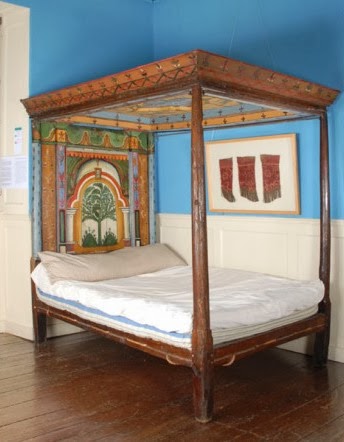
One of the items I illustrated was a painted four-poster bedstead (shown here) inscribed with initials and the date 1724. Divorced from its context it would have been described in a London showroom as "Probably Continental" and sold as a pretty "decorator's piece". But it was found in its original context, a cottage in Kirkbride, together with related items, and research gave us the precise details of its history. It is a rare testimonial of a tradition of painted vernacular furniture in Cumbria and the complete history illuminates a regional lifestyle. 

Another of the items I illustrated was a plain pine chest with canted sides and traces of rope handles. Divorced from its context it wouldn't have even made it to a London showroom but woould have ended up as firewood. But it was found in its original context, a cabin on the Mary Rose. Since it was found together with over forty other chests and countless other artefacts on that ship (plus the ship itself), we have the tools to help us interpret the past. We not only have a much clearer idea of vernacular furniture of the Tudor period but are blessed with a whole microcosm of that era. 

Neither the bedstead nor the chest are "history"; it is a study of them combined with their context and other sources that provides the evidence on which history can be based.


PART TWO: Can we have some moderation please!

I will reply separately to Steven Broom's comment (quoted in the post above) that he enjoys finding artefacts and cannot see the harm as long as he acts responsibly.

"Historical finds [...] can be the trigger that fires up a society's interest in the past."

Absolutely true! Actually handling an ancient object - rather than merely viewing it in a museum case or in an illustration - sends a chill down my spine. It is a thrilling experience that makes the past seem almost tangible.

The thrill of actually finding the artefact yourself is even more exciting - and I don't think anyone in their right mind could object to you coming across the odd Roman coin or Anglo-Saxon brooch. But the keywords here are "acting responsibly".

You have commendably stressed that you act responsibly in recording and reporting your finds. But that facet of acting responsibly was only part of what I was getting at in my criticism of the attitude of many metal detectorists. Personally, I am convinced that one of the most vital facets of acting responsibly in any pursuit that may threaten a fragile resource (whether it's bird eggs, wildlife or ancient artefacts) can be summed up in a single word: moderation.

I understand there are literally thousands of metal detectorists armed with extremely sophisticated machines, many of whom go searching for ancient artefacts every chance they get and often even on large rallies - typically in the misguided notion that they are "saving history". They have their own magazines, clubs, blogs and forums, and are frequently featured in the news (which encourages thousands more to join them). That is not my idea of moderation.

I genuinely applaud your own ethical attitude, Steven, but it is the scale of metal detecting that I find worrying and many are nowhere near as ethical as you. Even if every item really was recorded and reported, the prospect of thousands of untrained amateurs sprawled over England and Wales selectively digging up thousands of ancient metal artefacts as fast as they can grab them is more than a little disconcerting to those of us who value the evidence of history. And no, ploughsoil is not a carte blanche.

I understand the thrill of finding things but let's scale it down a bit, can we?

AddThis

LinkWithin

Related Posts Plugin for WordPress, Blogger...